
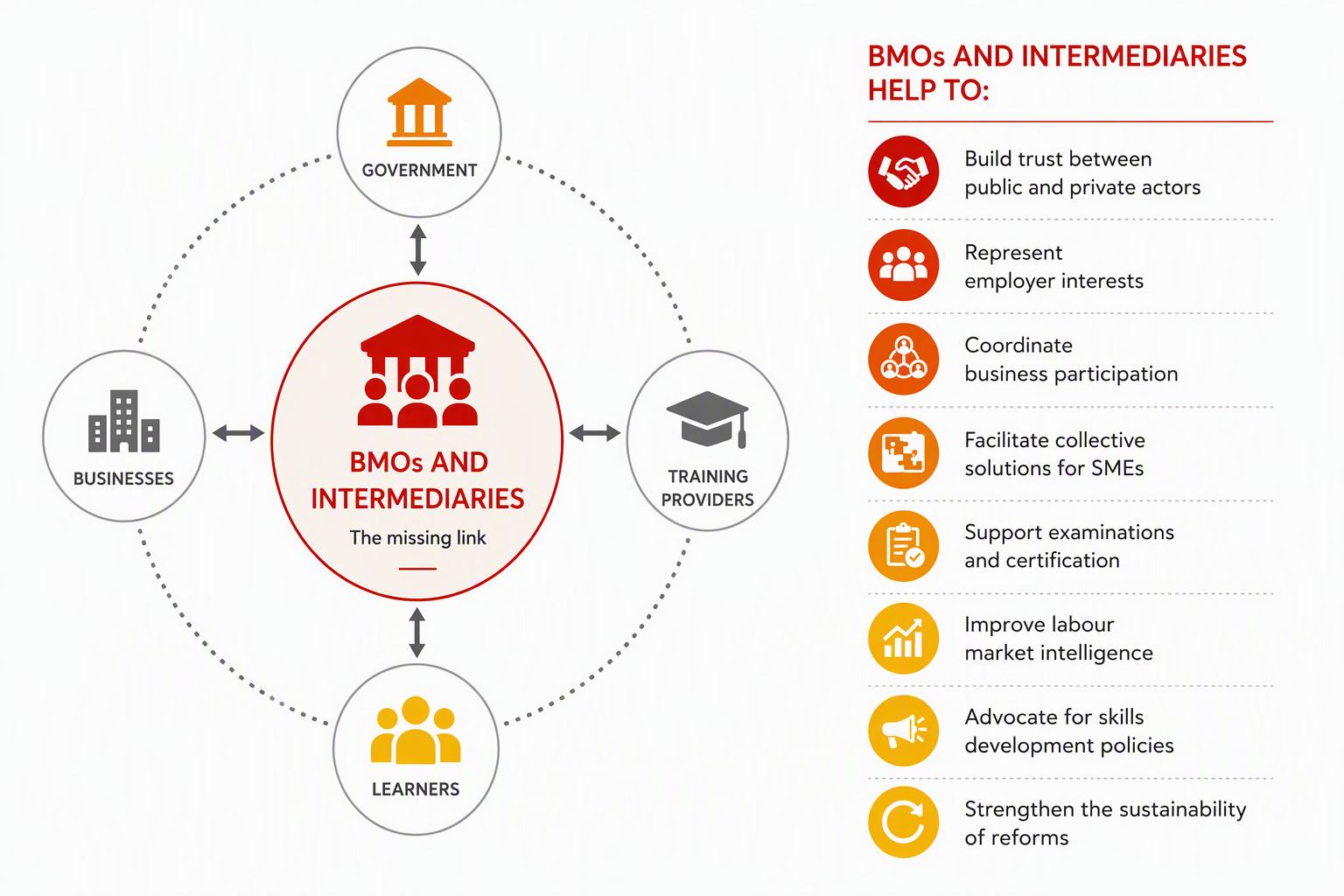
Business Membership Organisations (BMOs) and Intermediaries in Dual VET
- representing businesses collectively,
- coordinating stakeholder dialogue,
- supporting quality assurance,
- and advocating for skills development,
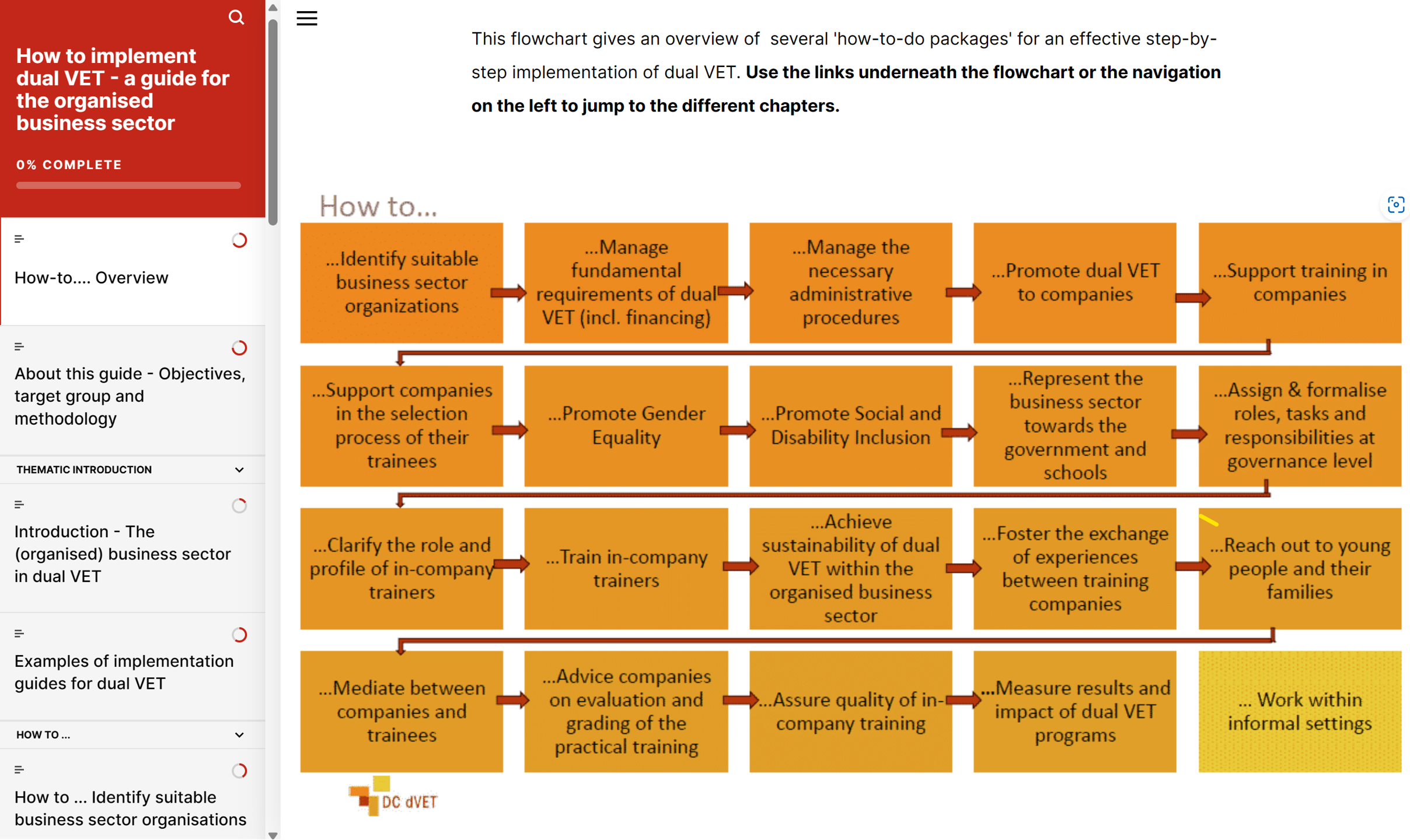
Practical Guide for the Organised Business Sector
How Can Business Associations Support Dual VET?
Business associations, chambers of commerce, employers’ organisations, and sector associations have a unique role to play in strengthening vocational education and training systems. But what does this role look like in practice, and where should organisations start?
The DC dVET Guide: How to Implement Dual VET provides practical guidance for organised business on how to contribute to the development, implementation, and governance of dual VET systems. Through interactive learning modules, examples, and practical tools, the guide explains how business organisations can represent employer interests, support companies, participate in skills governance, contribute to curriculum development, and promote work-based learning.
In this guide, you will learn:
- The principles and key elements of dual VET
- The role of chambers, business associations, and employers’ organisations
- How to engage companies in workplace learning
- How organised business can contribute to VET governance and quality assurance
- Practical approaches for strengthening cooperation between education and industry
- International examples and lessons learned from different countries
Webinar Series – Strengthening the Role of Business Associations in work-based and dualized Vocational Education and Training
The Role of Business Membership Organisations in Co-Governing Dual VET
How can chambers, employers’ associations and sector organisations contribute to the development and governance of work-based and dualized vocational education and training (VET) systems?
This webinar explores the critical role of Business Membership Organisations (BMOs) and other meso-level institutions in creating effective partnerships between the public and private sectors. Drawing on international experiences from Germany and Ecuador, the speakers discuss how chambers and business associations can represent employer interests, coordinate stakeholder engagement, support quality assurance, and contribute to the sustainable governance of dual VET systems.
The session combines a conceptual perspective on the role of intermediary organisations with practical examples of how business associations support skills development and employer engagement in different national contexts. It highlights both the opportunities and challenges of involving organised business in VET reforms and provides insights into how these roles can evolve as VET systems mature.
Key topics covered
- Co-governance and public-private partnerships in VET
- The role of chambers and business associations in skills development
- Supporting employer engagement and workplace learning
- Lessons from Germany, Senegal, Ethiopia, and Ecuador
- Practical implications for VET reforms in emerging and developing economies
Watch the video series below to learn how organised business can become a driver of effective and sustainable dual VET systems.
Representing the Voice of Employers – From Company Needs to Sector Skills Agendas
How can business associations move beyond representing individual company concerns and become a strategic voice for skills development at sector level?
This webinar explores one of the most important functions of Business Membership Organisations (BMOs): identifying, consolidating, and communicating employers’ skills needs to inform vocational education and training (VET) policies and programmes. Effective employer representation is essential for ensuring that VET systems respond to labour market demand and support economic competitiveness.
Drawing on experiences from North Macedonia and Ecuador, the session examines how chambers and business associations can collect labour market intelligence, engage employers through surveys and consultation mechanisms, and translate skills needs into concrete outputs such as sector skills agendas, curriculum recommendations, and policy proposals.
The webinar also highlights how BMOs can move from a reactive role to a more proactive position, actively shaping skills development systems rather than waiting to be consulted by government or training providers.
Key topics covered
- Representing sector-wide employer interests
- Identifying and analysing skills needs
- Developing Sector Skills Agenda proposals
- Translating employer demand into policy and curriculum inputs
- Building a proactive role for business associations
- International examples from North Macedonia and Ecuador
Video contributions:
- Ingrid Portenkirchner (DC dVET): Developing evidence-based sector positions
- Boris Trimcev (North Macedonia) and Natasha Janevska (Economic Chamber of North Macedonia: The Role of the Economic Chamber of North Macedonia in Dual VET – Introduction of a skills forecast model
- María José Hernández (Chamber of Industries and Production, Ecuador): Dual Training tailormade for Tourism Operators in Galápagos Islands
Keynote input on how to get from individual company voices to sector positions concerning skills needs and two case snapshots from North Macedonia and Ecuador
Making Co-Governance Work: How committees, working groups and advisory bodies can effectively steer dual VET
This session of the DC dVET webinar series on strengthening the role of organised business in dual VET explored how committees, working groups and advisory bodies can become effective platforms for co-governance, rather than structures that merely exist on paper. Drawing on practical experiences from Albania, Germany, North Macedonia, Mexico and Georgia, the webinar showed that there is no single model for successful co-governance. Structures need to reflect the institutional, economic and social context in which they operate.
Across the different country experiences, several success factors emerged:
- Clear purpose, mandate and responsibilities: Members need to understand why the body exists, what it can decide and what is expected from each actor.
- The right actors at the table: Meaningful representation of employers and their organisations, public authorities, VET providers and, where relevant, trade unions and other stakeholders strengthens both the quality and legitimacy of decisions.
- Effective facilitation and follow-up: A capable secretariat or coordinating organisation is essential for preparing meetings, facilitating dialogue, documenting decisions and ensuring that agreed actions are implemented.
- Trust, commitment and continuity: Effective co-governance develops over time through reliable collaboration, transparent communication and the experience that participation leads to tangible results.
- Start small and build from experience: Rather than creating overly complex structures from the outset, successful initiatives can begin with committed actors and concrete issues, demonstrate value and gradually evolve into more institutionalised forms of cooperation.
- Turn evidence and dialogue into action: Employers are more likely to remain engaged when their input visibly informs qualifications, curricula, training approaches and policy decisions.
The country cases also demonstrate that different pathways can lead to effective co-governance. Albania has established legally anchored Sector Skills Committees that connect labour-market evidence with the development of qualifications; Germany illustrates a highly institutionalised model of shared decision-making, while the experience from North Macedonia shows how cooperation can start with a small group of committed companies and gradually develop towards a more formalised public-private structure. Mexico highlights the interaction between private-sector coordination and national-level public-private governance, while the experience from Georgia underscores the importance of moving from dialogue and consultation towards continuous mechanisms that translate employer needs into concrete solutions.