
Projects on stage
In the “projects on stage” series, we present exciting and inspiring projects from the DC dVET members that implement a dual or dualised approach. With this series, we intend to make “dual” more tangible using project examples.
Education for Employment (E4E) North Macedonia
Intro
North Macedonia faces persistent labor market challenges, including skills mismatches, youth unemployment, and difficulties for companies, particularly small and medium-sized enterprises, to find workers with relevant vocational skills. These challenges are reflected in the vocational education and training system, where graduates have not consistently met the evolving needs of the labor market. The project of the Swiss Agency for Development and Cooperation, Education for Employment (E4E), works to strengthen the link between vocational education and employment by promoting market-oriented, inclusive, and sustainable vocational skills development. With a strong focus on advancing dual VET models, E4E supports systemic improvements that enable young people to acquire skills demanded by employers and improve their prospects for decent employment.
Context
North Macedonia is a small Western Balkan country with a population of approximately 1.8 million. Secondary education is mandatory, with around 17.000 students enrolling each year. The private sector is dominated by small and medium-sized enterprises, influencing the capacity of companies to engage in dual VET and to absorb graduates. Since 2018, dual VET has been gradually introduced in a context where traditional VET pathways were not sufficiently aligned with labor-market needs. At the same time, sustained outward migration, particularly among young people, has intensified skills shortages and increased the importance of VET as a tool for improving employability and retaining talent.

Topics
- Policy Dialogue on Dual VET
Supporting evidence-based policy dialogue and regulatory frameworks that enable the introduction, implementation, and scaling of dual VET.
- Work-Based Learning
Combining school-based learning with structured workplace training to ensure dual VET programs meet labour-market needs.
- Financing Dual VET
Improving education financing arrangements to reflect the cost structure of vocational and dual VET, ensuring sustainability.
- Promoting Dual VET
Raising awareness and enhancing the attractiveness of vocational education and skilled occupations among young people, parents, and employers.
- Schools and Business Partnership for Dual VET
Strengthening cooperation between schools, companies, and institutions to share responsibility for delivering market-relevant vocational education and training.
Key resources of the E4E Project
S4J Albania: Empower VET schools to take over key coordination roles
In dual VET systems like those in Germany, Austria, and Switzerland, strong intermediary organizations—such as business associations—are essential for coordinating training companies, setting standards, and ensuring quality. However, in contexts where such intermediaries are weak or absent, alternative models are needed. “Skills for Jobs” (S4J), a SDC project implemented in Albania by Swisscontact, demonstrates that VET schools can successfully assume key coordination roles, effectively filling gaps typically covered by business associations.
Approach, facts and tools: In the videos you learn more about this project
Interview with Fation D. (Programme Manager S4J)
Image video S4J Project (in albanian)
In Albania, the absence of strong business associations has limited cross-sector coordination in vocational training. To address this, the “Skills for Jobs” (S4J) project empowered vocational schools to take on greater responsibility by establishing internal “Development Units.” These units serve as hubs for innovation and coordination—building trust with local businesses, adapting curricula to labour market needs, and supporting companies in delivering training.
Key Functions of Development Units are:
- Continuous professional development for teachers
- Curricula development at school level
- Relationship management with companies
- Career orientation for students/trainees
- Design of projects for external funding
- Marketing
- Tracer study development and implementation
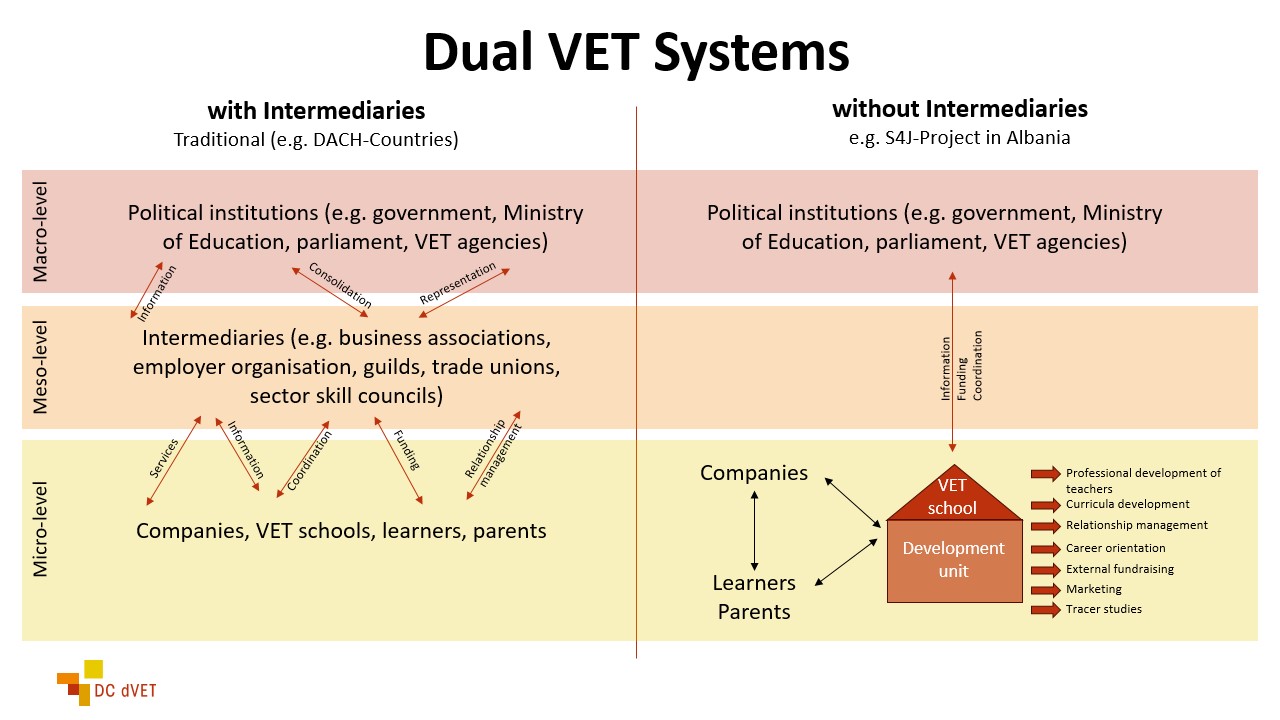
A key innovation of the S4J project in Albania is the expanded role of teachers within vocational schools. Through Development Units, teachers coordinate work-based learning, engage with local businesses, and access new professional pathways—addressing concerns about reduced classroom time in dual VET systems. This school-led model empowers educators as facilitators of reform and demonstrates that, even without strong intermediary organizations, schools can effectively drive dual VET implementation from within.
Key resources of the S4J Project
Build4Skills: Integration of practical training in infrastructure projects
The Build4Skills project – commissioned by BMZ and implemented by GIZ – marks the beginning of this new format. The project uses the potential of the infrastructure sector for practical learning and training. The approach is implemented in several countries including Pakistan, Mongolia and Kenya.
Approach, facts and tools: In the video you learn more about this project and under key resources you find more tools and references (more links are embedded in the video)
Key resources of the Build4Skills project (for more details click on the links embedded in the video):